This PR touches up a few small things in the project read model.

Fixes:
Use the right method name in the query/method timer for
`getProjectsForAdminUi`. I'd forgotten to change the timer name from the
original method name.

Spells the method name correctly for the `getMembersCount` timer (it
used to be `getMemberCount`, but the method is callled `getMembersCount`
with a plural s).

Changes:
Call the `getMembersCount` timer from within the `getMembersCount`
method itself. Instead of setting that timer up from two different
places, we can call it in the method we're timing. This wasn't a problem
previously, because the method was only called from a single place.
Assuming we always wanna time that query, it makes more sense to put the
timing in the actual method.
Hooks up the new project read model and updates the existing project
service to use it instead when the flag is on.

In doing:
- creates a composition root for the read model
- includes it in IUnleashStores
- updates some existing methods to accept either the old or the new
model
- updates the OpenAPI schema to deprecate the old properties
Creates a new project read model exposing data to be used for the UI and
for the insights module.

The model contains two public methods, both based on the project store's
`getProjectsWithCounts`:
- `getProjectsForAdminUi`
- `getProjectsForInsights`

This mirrors the two places where the base query is actually in use
today and adapts the query to those two explicit cases.

The new `getProjectsForAdminUi` method also contains data for last flag
update and last flag metric reported, as required for the new projects
list screen.

Additionally the read model contains a private `getMembersCount` method,
which is also lifted from the project store. This method was only used
in the old `getProjectsWithCounts` method, so I have also removed the
method from the public interface.

This PR does *not* hook up the new read model to anything or delete any
existing uses of the old method.

## Why?

As mentioned in the background, this query is used in two places, both
to get data for the UI (directly or indirectly). This is consistent with
the principles laid out in our [ADR on read vs write
models](https://docs.getunleash.io/contributing/ADRs/back-end/write-model-vs-read-models).

There is an argument to be made, however, that the insights module uses
this as an **internal** read model, but the description of an internal
model ("Internal read models are typically narrowly focused on answering
one question and usually require simple queries compared to external
read models") does not apply here. It's closer to the description of
external read models: "View model will typically join data across a few
DB tables" for display in the UI.

## Discussion points

### What about properties on the schema that are now gone?

The `project-schema`, which is delivered to the UI through the
`getProjects` endpoint (and nowhere else, it seems), describes
properties that will no longer be sent to the front end, including
`defaultStickiness`, `avgTimeToProduction`, and more. Can we just stop
sending them or is that a breaking change?

The schema does not define them as required properties, so in theory,
not sending them isn't breaking any contracts. We can deprecate the
properties and just not populate them anymore.

At least that's my thought on it. I'm open to hearing other views.

### Can we add the properties in fewer lines of code?

Yes! The [first commit in this PR
(b7534bfa)](b7534bfa07)
adds the two new properties in 8 lines of code.

However, this comes at the cost of diluting the `getProjectsWithCounts`
method further by adding more properties that are not used by the
insights module. That said, that might be a worthwhile tradeoff.

## Background

_(More [details in internal slack
thread](https://unleash-internal.slack.com/archives/C046LV6HH6W/p1723716675436829))_

I noticed that the project store's `getProjectWithCounts` is used in
exactly two places:

1. In the project service method which maps directly to the project
controller (in both OSS and enterprise).
2.  In the insights service in enterprise.

In the case of the controller, that’s the termination point. I’d guess
that when written, the store only served the purpose of showing data to
the UI.

In the event of the insights service, the data is mapped in
getProjectStats.
But I was a little surprised that they were sharing the same query, so I
decided to dig a little deeper to see what we’re actually using and what
we’re not (including the potential new columns). Here’s what I found.

Of the 14 already existing properties, insights use only 7 and the
project list UI uses only 10 (though the schema mentions all 14 (as far
as I could tell from scouring the code base)). Additionally, there’s two
properties that I couldn’t find any evidence of being used by either:
-   default stickiness
-   updatedAt (this is when the project was last updated; not its flags)
During adding privateProjectsChecker, I saw that events composition root
is not used almost at all.
Refactored code so we do not call new EventService anymore.
<!-- Thanks for creating a PR! To make it easier for reviewers and
everyone else to understand what your changes relate to, please add some
relevant content to the headings below. Feel free to ignore or delete
sections that you don't think are relevant. Thank you! ❤️ -->

## About the changes

When reading feature env strategies and there's no segments it returns
empty list of segments now. Previously it was undefined leading to
overly verbose change request diffs.

<img width="669" alt="Screenshot 2024-08-14 at 16 06 14"
src="https://github.com/user-attachments/assets/1ac6121b-1d6c-48c6-b4ce-3f26c53c6694">


### Important files
<!-- PRs can contain a lot of changes, but not all changes are equally
important. Where should a reviewer start looking to get an overview of
the changes? Are any files particularly important? -->


## Discussion points
<!-- Anything about the PR you'd like to discuss before it gets merged?
Got any questions or doubts? -->
For easy gitar integration, we need to have boolean in the event
payload.
We might rethink it when we add variants, but currently enabled with
variants is not used.
Changes the event search handling, so that searching by user uses the
user's ID, not the "createdBy" name in the event. This aligns better
with what the OpenAPI schema describes it.
Adds an endpoint to return all event creators.

An interesting point is that it does not return the user object, but
just created_by as a string. This is because we do not store user IDs
for events, as they are not strictly bound to a user object, but rather
a historical user with the name X.
Previously people were able to send random data to feature type. Now it
is validated.

Fixes https://github.com/Unleash/unleash/issues/7751

---------

Co-authored-by: Thomas Heartman <thomas@getunleash.io>
Changed the url of event search to search/events to align with
search/features. With that created a search controller to keep all
searches under there.
Added first test.
https://linear.app/unleash/issue/2-2469/keep-the-latest-event-for-each-integration-configuration

This makes it so we keep the latest event for each integration
configuration, along with the previous logic of keeping the latest 100
events of the last 2 hours.

This should be a cheap nice-to-have, since now we can always know what
the latest integration event looked like for each integration
configuration. This will tie-in nicely with the next task of making the
latest integration event state visible in the integration card.

Also improved the clarity of the auto-deletion explanation in the modal.
https://linear.app/unleash/issue/2-2439/create-new-integration-events-endpointhttps://linear.app/unleash/issue/2-2436/create-new-integration-event-openapi-schemas
This adds a new `/events` endpoint to the Addons API, allowing us to
fetch integration events for a specific integration configuration id.
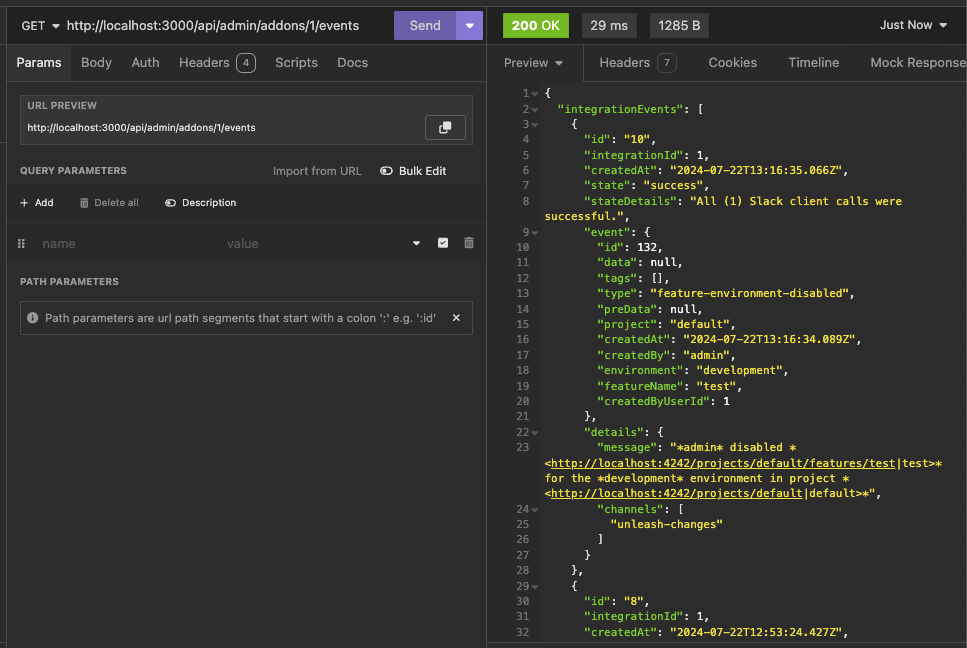
Also includes:
- `IntegrationEventsSchema`: New schema to represent the response object
of the list of integration events;
- `yarn schema:update`: New `package.json` script to update the OpenAPI
spec file;
- `BasePaginationParameters`: This is copied from Enterprise. After
merging this we should be able to refactor Enterprise to use this one
instead of the one it has, so we don't repeat ourselves;
We're also now correctly representing the BIGSERIAL as BigInt (string +
pattern) in our OpenAPI schema. Otherwise our validation would complain,
since we're saying it's a number in the schema but in fact returning a
string.
This PR allows you to gradually lower constraint values, even if they're
above the limits.

It does, however, come with a few caveats because of how Unleash deals
with constraints:
Constraints are just json blobs. They have no IDs or other
distinguishing features. Because of this, we can't compare the current
and previous state of a specific constraint.

What we can do instead, is to allow you to lower the amount of
constraint values if and only if the number of constraints hasn't
changed. In this case, we assume that you also haven't reordered the
constraints (not possible from the UI today). That way, we can compare
constraint values between updated and existing constraints based on
their index in the constraint list.

It's not foolproof, but it's a workaround that you can use. There's a
few edge cases that pop up, but that I don't think it's worth trying to
cover:

Case: If you **both** have too many constraints **and** too many
constraint values
Result: You won't be allowed to lower the amount of constraints as long
as the amount of strategy values is still above the limit.
Workaround: First, lower the amount of constraint values until you're
under the limit and then lower constraints. OR, set the constraint you
want to delete to a constraint that is trivially true (e.g. `currentTime
> yesterday` ). That will essentially take that constraint out of the
equation, achieving the same end result.

Case: You re-order constraints and at least one of them has too many
values
Result: You won't be allowed to (except for in the edge case where the
one with too many values doesn't move or switches places with another
one with the exact same amount of values).
Workaround: We don't need one. The order of constraints has no effect on
the evaluation.
https://linear.app/unleash/issue/2-2450/register-integration-events-webhook

Registers integration events in the **Webhook** integration.

Even though this touches a lot of files, most of it is preparation for
the next steps. The only actual implementation of registering
integration events is in the **Webhook** integration. The rest will
follow on separate PRs.

Here's an example of how this looks like in the database table:

```json
{
  "id": 7,
  "integration_id": 2,
  "created_at": "2024-07-18T18:11:11.376348+01:00",
  "state": "failed",
  "state_details": "Webhook request failed with status code: ECONNREFUSED",
  "event": {
    "id": 130,
    "data": null,
    "tags": [],
    "type": "feature-environment-enabled",
    "preData": null,
    "project": "default",
    "createdAt": "2024-07-18T17:11:10.821Z",
    "createdBy": "admin",
    "environment": "development",
    "featureName": "test",
    "createdByUserId": 1
  },
  "details": {
    "url": "http://localhost:1337",
    "body": "{ \"id\": 130, \"type\": \"feature-environment-enabled\", \"createdBy\": \"admin\", \"createdAt\": \"2024-07-18T17: 11: 10.821Z\", \"createdByUserId\": 1, \"data\": null, \"preData\": null, \"tags\": [], \"featureName\": \"test\", \"project\": \"default\", \"environment\": \"development\" }"
  }
}
```
This PR updates the limit validation for constraint numbers on a single
strategy. In cases where you're already above the limit, it allows you
to still update the strategy as long as you don't add any **new**
constraints (that is: the number of constraints doesn't increase).

A discussion point: I've only tested this with unit tests of the method
directly. I haven't tested that the right parameters are passed in from
calling functions. The main reason being that that would involve
updating the fake strategy and feature stores to sync their flag lists
(or just checking that the thrown error isn't a limit exceeded error),
because right now the fake strategy store throws an error when it
doesn't find the flag I want to update.
https://linear.app/unleash/issue/2-2453/validate-patched-data-against-schema
This adds schema validation to patched data, fixing potential issues of
patching data to an invalid state.
This can be easily reproduced by patching a strategy constraints to be
an object (invalid), instead of an array (valid):
```sh
curl -X 'PATCH' \
'http://localhost:4242/api/admin/projects/default/features/test/environments/development/strategies/8cb3fec6-c40a-45f7-8be0-138c5aaa5263' \
-H 'accept: application/json' \
-H 'Content-Type: application/json' \
-d '[
{
"path": "/constraints",
"op": "replace",
"from": "/constraints",
"value": {}
}
]'
```
Unleash will accept this because there's no validation that the patched
data actually looks like a proper strategy, and we'll start seeing
Unleash errors due to the invalid state.
This PR adapts some of our existing logic in the way we handle
validation errors to support any dynamic object. This way we can perform
schema validation with any object and still get the benefits of our
existing validation error handling.
This PR also takes the liberty to expose the full instancePath as
propertyName, instead of only the path's last section. We believe this
has more upsides than downsides, especially now that we support the
validation of any type of object.

This PR adds prometheus metrics for when users attempt to exceed the
limits for a given resource.

The implementation sets up a second function exported from the
ExceedsLimitError file that records metrics and then throws the error.
This could also be a static method on the class, but I'm not sure that'd
be better.
PR #7519 introduced the pattern of using `createApiTokenService` instead
of newing it up. This usage was introduced in a concurrent PR (#7503),
so we're just cleaning up and making the usage consistent.
Deletes API tokens bound to specific projects when the last project they're mapped to is deleted.

---------

Co-authored-by: Tymoteusz Czech <2625371+Tymek@users.noreply.github.com>
Co-authored-by: Thomas Heartman <thomas@getunleash.io>
If you have SDK tokens scoped to projects that are deleted, you should
not get access to any flags with those.

---------

Co-authored-by: David Leek <david@getunleash.io>
This PR adds a feature flag limit to Unleash. It's set up to be
overridden in Enterprise, where we turn the limit up.

I've also fixed a couple bugs in the fake feature flag store.
This adds an extended metrics format to the metrics ingested by Unleash
and sent by running SDKs in the wild. Notably, we don't store this
information anywhere new in this PR, this is just streamed out to
Victoria metrics - the point of this project is insight, not analysis.

Two things to look out for in this PR:

- I've chosen to take extend the registration event and also send that
when we receive metrics. This means that the new data is received on
startup and on heartbeat. This takes us in the direction of collapsing
these two calls into one at a later point
- I've wrapped the existing metrics events in some "type safety", it
ain't much because we have 0 type safety on the event emitter so this
also has some if checks that look funny in TS that actually check if the
data shape is correct. Existing tests that check this are more or less
preserved
This fixes the issue where project names that are 100 characters long
or longer would cause the project creation to fail. This is because
the resulting ID would be longer than the 100 character limit imposed
by the back end.

We solve this by capping the project ID to 90 characters, which leaves
us with 10 characters for the suffix, meaning you can have 1 billion
projects (999,999,999 + 1) that start with the same 90
characters (after slugification) before anything breaks.

It's a little shorter than what it strictly has to be (we could
probably get around with 95 characters), but at this point, you're
reaching into edge case territory anyway, and I'd rather have a little
too much wiggle room here.
This PR removes the last two flags related to the project managament
improvements project, making the new project creation form GA.

In doing so, we can also delete the old project creation form (or at
least the page, the form is still in use in the project settings).
This PR:
- adds a flag to anonymize user emails in the new project cards
- performs the anonymization using the existing `anonymise` function
that we have.
It does not anonymize the system user, nor does it anonymize groups. It
does, however, leave the gravatar url unchanged, as that is already
hashed (but we may want to hide that too).
This PR also does not affect the user's name or username. Considering
the target is the demo instance where the vast majority of users don't
have this (and if they do, they've chosen to set it themselves), this
seems an appropriate mitigation.
With the flag turned off:

With the flag on:

Fix project role assignment for users with `ADMIN` permission, even if
they don't have the Admin root role. This happens when e.g. users
inherit the `ADMIN` permission from a group root role, but are not
Admins themselves.

---------

Co-authored-by: Gastón Fournier <gaston@getunleash.io>
This PR adds metrics tracking for:
- "maxConstraintValues": the highest number of constraint values that
are in use
- "maxConstraintsPerStrategy": the highest number of constraints used on
a strategy

It updates the existing feature strategy read model that returns max
metrics for other strategy-related things.

It also moves one test into a more fitting describe block.
Instead of running exists on every row, we are joining the exists, which
runs the query only once.
This decreased load time on my huge dataset from 2000ms to 200ms.

Also added tests that values still come through as expected.
Instead of running exists on every row, we are joining the exists, which
runs the query only once.
This decreased load time on my huge dataset from 2000ms to 200ms.

Also added tests that values still come through as expected.
**Upgrade to React v18 for Unleash v6. Here's why I think it's a good
time to do it:**
- Command Bar project: We've begun work on the command bar project, and
there's a fantastic library we want to use. However, it requires React
v18 support.
- Straightforward Upgrade: I took a look at the upgrade guide
https://react.dev/blog/2022/03/08/react-18-upgrade-guide and it seems
fairly straightforward. In fact, I was able to get React v18 running
with minimal changes in just 10 minutes!
- Dropping IE Support: React v18 no longer supports Internet Explorer
(IE), which is no longer supported by Microsoft as of June 15, 2022.
Upgrading to v18 in v6 would be a good way to align with this change.

TS updates:
* FC children has to be explicit:
https://stackoverflow.com/questions/71788254/react-18-typescript-children-fc
* forcing version 18 types in resolutions:
https://sentry.io/answers/type-is-not-assignable-to-type-reactnode/

Test updates:
* fixing SWR issue that we have always had but it manifests more in new
React (https://github.com/vercel/swr/issues/2373)

---------

Co-authored-by: kwasniew <kwasniewski.mateusz@gmail.com>
This PR removes the flag for the new project card design, making it GA.

It also removes deprecated components and updates one reference (in the
groups card) to the new components instead.
## About the changes

Removes the deprecated state endpoint, state-service (despite the
service itself not having been marked as deprecated), and the file
import in server-impl. Leaves a TODO in place of where file import was
as traces for a replacement file import based on the new import/export
functionality
## About the changes
This aligns us with the requirement of having ip in all events. After
tackling the enterprise part we will be able to make the ip field
mandatory here:
2c66a4ace4/src/lib/types/events.ts (L362)
In preparation for v6, this PR removes usage and references to
`error.description` instead favoring `error.message` (as mentioned
#4380)

I found no references in the front end, so this might be (I believe it
to be) all the required changes.
This PR is part of #4380 - Remove legacy `/api/feature` endpoint.

## About the changes

### Frontend
- Removes the useFeatures hook
- Removes the part of StrategyView that displays features using this
strategy (not been working since v4.4)
- Removes 2 unused features entries from routes

### Backend
- Removes the /api/admin/features endpoint
- Moves a couple of non-feature related tests (auth etc) to use
/admin/projects endpoint instead
- Removes a test that was directly related to the removed endpoint
- Moves a couple of tests to the projects/features endpoint
- Reworks some tests to fetch features from projects features endpoint
and strategies from project strategies
1. Added new schema and tests
2. Controller also accepts the data
3. Also sending fake data from frontend currently

Next steps, implement service/store layer and frontend
Now we are also sending project id to prometheus, also querying from
database. This sets us up for grafana dashboard.
Also put the metrics behind flag, just incase it causes cpu/memory
issues.
This PR updates the project service to automatically create a project id
if it is not provided. The feature is behind a flag. If an ID is
provided, it will still attempt to use that ID instead.
This PR adds a function to automatically generate a project ID on
creation. Using this when the id is missing will be handled in following
PRs.

The function uses the existing `slug` package to create a slug, and then
takes the 12 characters of a uuidv4 string to generate an ID.

The included tests check that the 12 character hash is added and that
the resulting string is url friendly (by checking that
`encodeURIComponent` doesn't change it).

We could also test a lot of edge cases (such as dealing with double
spaces, trimming the string, etc), but I think that's better handled by
the library itself (but you can check out what I removed in
2d9bcb6390
for an idea).

The function doesn't really need to be in the service; it could be moved to a util. But for proximity, I'll create it here first.
Final rank has always been ordering correctly by default. But after 5.12
I see some issues that sometimes it is not ordered. Just to be extra
sure, I am for ordering it.
This PR removes the workaround introduced in
https://github.com/Unleash/unleash/pull/6931. After
https://github.com/ivarconr/unleash-enterprise/pull/1268 has been
merged, this should be safe to apply.

Notably, this PR:
- tightens up the type for the enable change request function, so we can
use that to inform the code
- skips trying to do anything with an empty array

The last point is less important than it might seem because both the env
validation and the current implementation of the callback is essentially
a no-op when there are no envs. However, that's hard to enforce. If we
just exit out early, then at least we know nothing happens.

Optionally, we could do something like this instead, but I'm not sure
it's better or worse. Happy to take input.
```ts
            const crEnvs = newProject.changeRequestEnvironments ?? []
            await this.validateEnvironmentsExist(crEnvs.map((env) => env.name));
            const changeRequestEnvironments =
                await enableChangeRequestsForSpecifiedEnvironments(crEnvs,);

            data.changeRequestEnvironments = changeRequestEnvironments;
```


