## About the changes

Removes the deprecated state endpoint, state-service (despite the
service itself not having been marked as deprecated), and the file
import in server-impl. Leaves a TODO in place of where file import was
as traces for a replacement file import based on the new import/export
functionality
1. Added new schema and tests
2. Controller also accepts the data
3. Also sending fake data from frontend currently

Next steps, implement service/store layer and frontend
This PR expands upon #6773 by returning the list of removed properties
in the API response. To achieve this, I added a new top-level `warnings`
key to the API response and added an `invalidContextProperties` property
under it. This is a list with the keys that were removed.

## Discussion points

**Should we return the type of each removed key's value?** We could
expand upon this by also returning the type that was considered invalid
for the property, e.g. `invalidProp: 'object'`. This would give us more
information that we could display to the user. However, I'm not sure
it's useful? We already return the input as-is, so you can always
cross-check. And the only type we allow for non-`properties` top-level
properties is `string`. Does it give any useful info? I think if we want
to display this in the UI, we might be better off cross-referencing with
the input?

**Can properties be invalid for any other reason?** As far as I can
tell, that's the only reason properties can be invalid for the context.
OpenAPI will prevent you from using a type other than string for the
context fields we have defined and does not let you add non-string
properties to the `properties` object. So all we have to deal with are
top-level properties. And as long as they are strings, then they should
be valid.

**Should we instead infer the diff when creating the model?** In this
first approach, I've amended the `clean-context` function to also return
the list of context fields it has removed. The downside to this approach
is that we need to thread it through a few more hoops. Another approach
would be to compare the input context with the context used to evaluate
one of the features when we create the view model and derive the missing
keys from that. This would probably work in 98 percent of cases.
However, if your result contains no flags, then we can't calculate the
diff. But maybe that's alright? It would likely be fewer lines of code
(but might require additional testing), although picking an environment
from feels hacky.
Adds a bearer token middleware that adds support for tokens prefixed
with "Bearer" scheme. Prefixing with "Bearer" is optional and the old
way of authenticating still works, so we now support both ways.
Also, added as part of our OpenAPI spec which now displays authorization
as follows:

Related to #4630. Doesn't fully close the issue as we're still using
some invalid characters for the RFC, in particular `*` and `[]`
For safety reasons this is behind a feature flag
---------
Co-authored-by: Gastón Fournier <gaston@getunleash.io>
This change fixes the OpenAPI schema to disallow non-string properties
on the top level of the context (except, of course, the `properties`
object).

This means that we'll no longer be seeing issues with rendering
invalid contexts, because we don't accept them in the first place.

This solution comes with some tradeoffs discussed in the [PR](https://github.com/Unleash/unleash/pull/6676). Following on from that, this solution isn't optimal, but it's a good stop gap. A better solution (proposed in the PR discussion) has been added as an idea for future projects.

The bulk of the discussion around the solution is included here for reference:

@kwasniew:
Was it possible to pass non string properties with our UI before?
Is there a chance that something will break after this change?

@thomasheartman:
Good question and good looking out 😄

You **could** pass non-string, top-level properties into the API before. In other words, this would be allowed:

```js
{
  appName: "my-app",
  nested: { object: "accepted" }
}
```

But notably, non-string values under `properties` would **not** be accepted:

```js
{
  appName: "my-app",
  properties: {
    nested: { object: "not accepted" }
  }
}
```

**However**, the values would not contribute to the evaluation of any constraints (because their type is invalid), so they would effectively be ignored.

Now, however, you'll instead get a 400 saying that the "nested" value must be a string.

I would consider this a bug fix because:
- if you sent a nested object before, it was most likely an oversight
- if you sent the nested object on purpose, expecting it to work, you would be perplexed as to why it didn't work, as the API accepted it happily

Furthermore, the UI will also tell you that the property must be a string now if you try to do it from the UI.

On the other hand, this does mean that while you could send absolute garbage in before and we would just ignore it, we don't do that anymore. This does go against how we allow you to send anything for pretty much all other objects in our API.

However, the SDK context is special. Arbitrary keys aren't ignored, they're actually part of the context itself and as such should have a valid value.

So if anything breaks, I think it breaks in a way that tells you why something wasn't working before. However, I'd love to hear your take on it and we can re-evaluate whether this is the right fix, if you think it isn't.

@kwasniew:
Coming from the https://en.wikipedia.org/wiki/Robustness_principle mindset I'm thinking if ignoring the fields that are incorrect wouldn't be a better option. So we'd accept incorrect value and drop it instead of:
* failing with client error (as this PR) or
* saving incorrect value (as previous code we had)

@thomasheartman:
Yeah, I considered that too. In fact, that was my initial idea (for the reason you stated). However, there's a couple tradeoffs here (as always):

1. If we just ignore those values, the end user doesn't know what's happened unless they go and dig through the responses. And even then, they don't necessarily know why the value is gone.
2. As mentioned, for the context, arbitrary keys can't be ignored, because we use them to build the context. In other words, they're actually invalid input.

Now, I agree that you should be liberal in what you accept and try to handle things gracefully, but that means you need to have a sensible default to fall back to. Or, to quote the Wikipedia article (selectively; with added emphasis):

> programs that receive messages should accept non-conformant input **as long as the meaning is clear**.

In this case, the meaning isn't clear when you send extra context values that aren't strings.
For instance, what's the meaning here:

```js
{
  appName: "my-app",
  nested: { object: "accepted", more: { further: "nesting" } }
}
```

If you were trying to use the `nested` value as an object, then that won't work. Ideally, you should be alerted.

Should we "unwind" the object and add all string keys as context values? That doesn't sound very feasible **or** necessarily like the right thing.

Did you just intend to use the `appName` and for the `nested` object to be ignored?

And it's because of this caveat that I'm not convinced just ignoring the keys are the right thing to do. Because if you do, the user never knows they were ignored or why.

----

**However**, I'd be in favor of ignoring they keys if we could **also** give the users warnings at the same time. (Something like what we do in the CR api, right? Success with warnings?)

If we can tell the user that "we ignored the `a`, `b`, and `c` keys in the context you sent because they are invalid values. Here is the result of the evaluation without taking those keys into account: [...]", then I think that's the ideal solution.

But of course, the tradeoff is that that increases the complexity of the API and the complexity of the task. It also requires UI adjustments etc. This means that it's not a simple fix anymore, but more of a mini-project.

But, in the spirit of the playground, I think it would be a worthwhile thing to do because it helps people learn and understand how Unleash works.
This PR adds a property issues to application schema, and also adds all
the missing features that have been reported by SDK, but do not exist in
Unleash.
In order to prevent users from being able to assign roles/permissions
they don't have, this PR adds a check that the user performing the
action either is Admin, Project owner or has the same role they are
trying to grant/add.

This addAccess method is only used from Enterprise, so there will be a
separate PR there, updating how we return the roles list for a user, so
that our frontend can only present the roles a user is actually allowed
to grant.

This adds the validation to the backend to ensure that even if the
frontend thinks we're allowed to add any role to any user here, the
backend can be smart enough to stop it.

We should still update frontend as well, so that it doesn't look like we
can add roles we won't be allowed to.
Fixes ##5799 and #5785

When you do not provide a token we should resolve to the "default"
environment to maintain backward compatibility. If you actually provide
a token we should prefer that and even block the request if it is not
valid.

An interesting fact is that "default" environment is not available on a
fresh installation of Unleash. This means that you need to provide a
token to actually get access to toggle configurations.


---------

Co-authored-by: Thomas Heartman <thomas@getunleash.io>
Created a build script that generates orval schemas with automatic
cleanup. Also generating new ones.

1. yarn gen:api **(generates schemas)**
2. rm -rf src/openapi/apis **(remove apis)**
3.  sed -i '1q' src/openapi/index.ts **(remove all rows except first)**
This PR adds an endpoint to Unleash that accepts an error message and
option error stack and logs it as an error. This allows us to leverage
errors in logs observability to catch UI errors consistently.

Considered a test, but this endpoint only accepts and logs input, so I'm
not sure how useful it would be.
Adds a new Inactive Users list component to admin/users for easier cleanup of users that are counted as inactive: No sign of activity (logins or api token usage) in the last 180 days.

---------

Co-authored-by: David Leek <david@getunleash.io>
This backwards compatible change allows us to specify a schema `id`
(full path) which to me feels a bit better than specifying the schema
name as a string, since a literal string is prone to typos.

### Before

```ts
requestBody: createRequestSchema(
    'createResourceSchema',
),
responses: {
    ...getStandardResponses(400, 401, 403, 415),
    201: resourceCreatedResponseSchema(
        'resourceSchema',
    ),
},
```

### After

```ts
requestBody: createRequestSchema(
    createResourceSchema.$id,
),
responses: {
    ...getStandardResponses(400, 401, 403, 415),
    201: resourceCreatedResponseSchema(
        resourceSchema.$id,
    ),
},
```
## About the changes

Adds the new nullable column created_by_user_id to the data used by
feature-tag-store and feature-tag-service. Also updates openapi schemas.
I noticed I was getting warnings logged in my local instance when
visiting the users page (`/admin/users`)

```json
{
    "schema": "#/components/schemas/publicSignupTokensSchema",
    "errors": [
        {
            "instancePath": "/tokens/0/users/0/username",
            "schemaPath": "#/components/schemas/userSchema/properties/username/type",
            "keyword": "type",
            "params": {
                "type": "string"
            },
            "message": "must be string"
        }
    ]
}
```

It was complaining because one of my users doesn't have a username, so
the value returned from the API was:

```json
{
    "users": [
        {
            "id": 2,
            "name": "2mas",
            "username": null
        }
    ]
}
```

This adjustment fixes that oversight by allowing `null` values for the
username.
### What
Adds `createdByUserId` to all events exposed by unleash. In addition
this PR updates all tests and usages of the methods in this codebase to
include the required number.
This change adds a property to the segmentStrategiesSchema to make sure
that change request strategies are listed in the openapi spec

It also renames the files that contains that schema and its tests from
`admin-strategies-schema` to `segment-strategies-schema`.
Adding new project overview endpoint and deprecating the old one.
The new one has extra info about feature types, but does not have
features anymore, because features are coming from search endpoint.
This PR adds the ability to detect which strategies use a specific
segment in active change requests.

It does not wire this functionality up to anything just yet. Follow-up
PRs will integrate this with the segment service and eventually with the
front end.
This PR updates the segment usage counting to also include segment usage
in pending change requests.
The changes include:
- Updating the schema to explicitly call out that change request usage
is included.
- Adding two tests to verify the new features
- Writing an alternate query to count this data
Specifically, it'll update the part of the UI that tells you how many
places a segment is used:

## Implementation
Implementing this was a little tricky. Previously, we'd just count
distinct instances of feature names and project names on the
feature_strategy table. However, to merge this with change request data,
we can't just count existing usage and change request usage separately,
because that could cause duplicates.
Instead of turning this into a complex DB query, I've broken it up into
a few separate queries and done the merging in JS. I think that's more
readable and it was easier to reason about.
Here's the breakdown:
1. Get the list of pending change requests. We need their IDs and their
project.
2. Get the list of updateStrategy and addStrategy events that have
segment data.
3. Take the result from step 2 and turn it into a dictionary of segment
id to usage data.
4. Query the feature_strategy_segment and feature_strategies table, to
get existing segment usage data
5. Fold that data into the change request data.
6. Perform the preexisting segment query (without counting logic) to get
other segment data
7. Enrich the results of the query from step 2 with usage data.
## Discussion points
I feel like this could be done in a nicer way, so any ideas on how to
achieve that (whether that's as a db query or just breaking up the code
differently) is very welcome.
Second, using multiple queries obviously yields more overhead than just
a single one. However, I do not think this is in the hot path, so I
don't consider performance to be critical here, but I'm open to hearing
opposing thoughts on this of course.
Switch the express-openapi implementation from our internal fork to the
upstream version. We have upstreamed our changes and a new version has
been released, so this should be the last step before we can retire our
fork.

Because some of the dependencies have been updated since our internal
fork, we also need to update some of our error handling to reflect this.
As part of more telemetry on the usage of Unleash.

This PR adds a new `stat_` prefixed table as well as a trigger on the
events table trigger on each insert to increment a counter per
environment per day.

The trigger will trigger on every insert into the events base, but will
filter and only increment the counter for events that actually have the
environment set. (there are events, like user-created, that does not
relate to a specific environment).

Bit wary on this, but since we truncate down to row per (day,
environment) combo, finding conflict and incrementing shouldn't take too
long here.

@ivarconr was it something like this you were considering?
This commit changes our linter/formatter to biome (https://biomejs.dev/)
Causing our prehook to run almost instantly, and our "yarn lint" task to
run in sub 100ms.

Some trade-offs:
* Biome isn't quite as well established as ESLint
* Are we ready to install a different vscode plugin (the biome plugin)
instead of the prettier plugin


The configuration set for biome also has a set of recommended rules,
this is turned on by default, in order to get to something that was
mergeable I have turned off a couple the rules we seemed to violate the
most, that we also explicitly told eslint to ignore.
We love all open-source Unleash users. in 2022 we built the [segment
capability](https://docs.getunleash.io/reference/segments) (v4.13) as an
enterprise feature, simplify life for our customers.

Now it is time to contribute it to the world 🌏

---------

Co-authored-by: Thomas Heartman <thomas@getunleash.io>
## About the changes
Open API code generator does not get along with `oneOf` alongside
`properties`:
```shell
$ openapi-generator-cli validate -i modified-openapi.json --recommend
Validating spec (modified-openapi.json)
Warnings:
        - Schemas defining properties and oneOf are not clearly defined in the OpenAPI
          Specification. While our tooling supports this, it may cause issues with other tools.
```


bab67e44e4/modules/openapi-generator/src/main/java/org/openapitools/codegen/validations/oas/OpenApiSchemaValidations.java (L25-L29)

This PR adds a meta-schema rule to validate this and fixes one issue
## About the changes
- `getActiveUsers` is using multiple stores, so it is refactored into
read-model
- Refactored Instance stats service into `features` to co-locate related
code

Closes https://linear.app/unleash/issue/UNL-230/active-users-prometheus

### Important files
`src/lib/features/instance-stats/getActiveUsers.ts`


## Discussion points
`getActiveUsers` is coded less _class-based_ then previous similar
read-models. In one file instead of 3 (read-model interface, fake read
model, sql read model). I find types and functions way more readable,
but I'm ready to refactor it to interfaces and classes if consistency is
more important.
https://linear.app/unleash/issue/2-1401/misc-fixes-and-improvements-related-to-the-new-slack-app-integration
This includes multiple UI-related misc fixes and improvements that are
not only related with the new Slack App integration but also
integrations in general.
- Improves the styling in the "how does it work" section;
- Improves the text in the `IntegrationMultiSelector`s;
- Switches "Configure" and "Open" around to match designs;
- Properly handles click event on `IntegrationCardMenu` (fix navigation
on dialog click);
- Fixes titles and contents for "enable/disable" and "delete"
integration dialogs to match designs;
- Updates Slack App integration "how does it work" section to better
reflect the intended behavior;
- Removes redundant alerts after previous point;
- Adds an alert in the old Slack integration configuration warning of
its deprecation and suggesting the new Slack App integration instead;
- Fixes typos;
- Slight refactors;

Co-authored by @nicolaesocaciu
This was changed a month ago, but it ends up breaking the frontend when
we regenerate the types because the playground needs to have this
structure for now. We'll need to add this back until we can rewrite the
playground to follow the schema.
Adds `number` as possible payload type for variant.
Adds a flag to enable the feature
Updates all relevant models and schemas
Adds the option to the UI

Closes: #
[1-1357](https://linear.app/unleash/issue/1-1357/support-number-in-variant-payload)

---------

Signed-off-by: andreas-unleash <andreas@getunleash.ai>
## About the changes
Create api token schema can either provide the field `project` or its
plural: `projects` so the joi validation makes them optional:
2be77fb55e/src/lib/schema/api-token-schema.ts (L20-L24)

This means that when returning the token, the response will either
contain `project` or `projects` depending on what was provided as input.
Therefore we need to make both fields optional in the response
This PR adds a feature naming pattern description to the project form.
It's rendered as a multi-line input field. The description is also
stored in the db.
This adapts most of @andreas-unleash's PR #4599 with some minor changes
(using description instead of prompt). Actually displaying this data to
the users will come in a later PR.

## About the changes
We found a problem generating the Go SDK client for the tokens API that
makes use of `oneOf`, combined with `allOf`. The generator doesn't know
how to map this type and leaves it as an object. This PR simplifies the spec and therefore the code generated after it
Adds a first iteration of feature flag naming patterns. Currently behind a flag.

Signed-off-by: andreas-unleash <andreas@getunleash.ai>
Co-authored-by: Thomas Heartman <thomas@getunleash.io>
Co-authored-by: andreas-unleash <andreas@getunleash.ai>
Co-authored-by: Thomas Heartman <thomas@getunleash.ai>
This change sorts the tags in the tags file and tests that the list is
sorted alphabetically. This makes it easier to
find tags in the file.

#4580 already introduced a test to check that we have no duplicate
tags, so this isn't as necessary anymore, but it's still nice to have.

It also removes the previous auto-sorting before exporting. This is to
ensure that entries are sorted in the source list. This might seem like
a regression, but it makes it easier to spot near-duplicate tags:

> Despite having the test that validates there are no duplicates, you
can always have Notifications and Notification API by mistake (tags that
mean the same but are different). Keeping the list alphabetically sorted
might help to prevent this before pushing the change to prod. In this
case, we will eventually find out and fix it, so this could be a good
reason to have the list sorted.
## About the changes
At https://github.com/Unleash/unleash/pull/4432 we've introduced the
same tags twice which causes issues when generating the api clients.

Closes #2-1350-fix-openapi-duplicated-tags
Unless you set `additionalProperties` to `false`, additional properties
are always
allowed. By explicitly setting it to `true` the generated
examples contain additional properties, e.g.:

```json
{
  "tokens": [
    "aproject:development.randomstring",
    "[]:production.randomstring"
  ],
  "additionalProp1": {}
}
```

By removing the explicit annotation, we still allow additional
properties, but we don't get them in examples:

```json
{
  "tokens": [
    "aproject:development.randomstring",
    "[]:production.randomstring"
  ]
}
```
https://linear.app/unleash/issue/2-1136/custom-root-roles-documentation

- [Adds documentation referencing custom root
roles](https://unleash-docs-git-docs-custom-root-roles-unleash-team.vercel.app/reference/rbac);
- [Adds a "How to create and assign custom root roles" how-to
guide](https://unleash-docs-git-docs-custom-root-roles-unleash-team.vercel.app/how-to/how-to-create-and-assign-custom-root-roles);
 - Standardizes "global" roles to "root" roles;
- Standardizes "standard" roles to "predefined" roles to better reflect
their behavior and what is shown in our UI;
 - Updates predefined role descriptions and makes them consistent;
 - Updates the side panel description of the user form;
- Includes some boy scouting with some tiny fixes of things identified
along the way (e.g. the role form was persisting old data when closed
and re-opened);

 Questions:

- Is it worth expanding the "Assigning custom root roles" section in the
"How to create and assign custom root roles" guide to include the steps
for assigning a root role for each entity (user, service account,
group)?
- Should this PR include an update to the existing "How to create and
assign custom project roles" guide? We've since updated the UI;

---------

Co-authored-by: Thomas Heartman <thomas@getunleash.ai>
Enable strict schema validation by default. It can still be overridden
by explicitly setting it to false.

I've also fixed the validation errors that appeared when turning it on.
I've opted for the simplest route and changed the schemas to comply with
the tests.
This PR adds an operation and accompanying openapi docs for the new
"update feature type lifetime" API operation.

It also fixes an oversight where the other endpoint on the same
controller didn't use `respondWithValidation`.

Note: the API here is a suggestion. I'd like to hear whether you agree
with this implementation or not.
<!-- Thanks for creating a PR! To make it easier for reviewers and
everyone else to understand what your changes relate to, please add some
relevant content to the headings below. Feel free to ignore or delete
sections that you don't think are relevant. Thank you! ❤️ -->
When reordering strategies for a feature environment:
- Adds stop when CR are enabled
- Emits an event

## About the changes
<!-- Describe the changes introduced. What are they and why are they
being introduced? Feel free to also add screenshots or steps to view the
changes if they're visual. -->

<!-- Does it close an issue? Multiple? -->
Closes #

<!-- (For internal contributors): Does it relate to an issue on public
roadmap? -->
<!--
Relates to [roadmap](https://github.com/orgs/Unleash/projects/10) item:
#
-->

### Important files
<!-- PRs can contain a lot of changes, but not all changes are equally
important. Where should a reviewer start looking to get an overview of
the changes? Are any files particularly important? -->


## Discussion points
<!-- Anything about the PR you'd like to discuss before it gets merged?
Got any questions or doubts? -->

---------

Signed-off-by: andreas-unleash <andreas@getunleash.ai>
This reverts commit 16e3799b9a.


<!-- Thanks for creating a PR! To make it easier for reviewers and
everyone else to understand what your changes relate to, please add some
relevant content to the headings below. Feel free to ignore or delete
sections that you don't think are relevant. Thank you! ❤️ -->

## About the changes
<!-- Describe the changes introduced. What are they and why are they
being introduced? Feel free to also add screenshots or steps to view the
changes if they're visual. -->

<!-- Does it close an issue? Multiple? -->
Closes #

<!-- (For internal contributors): Does it relate to an issue on public
roadmap? -->
<!--
Relates to [roadmap](https://github.com/orgs/Unleash/projects/10) item:
#
-->

### Important files
<!-- PRs can contain a lot of changes, but not all changes are equally
important. Where should a reviewer start looking to get an overview of
the changes? Are any files particularly important? -->


## Discussion points
<!-- Anything about the PR you'd like to discuss before it gets merged?
Got any questions or doubts? -->
https://linear.app/unleash/issue/2-1232/implement-first-iteration-of-the-new-slack-app-addon

This PR implements the first iteration of the new Slack App addon.
Unlike the old Slack addon, this one uses a Slack App (bot) that is
installed to Slack workspaces in order to post messages. This uses
`@slack/web-api`, which internally uses the latest Slack API endpoints
like `postMessage`.

This is currently behind a flag: `slackAppAddon`.

The current flow is that the Unleash Slack App is installed from
whatever source:
 - Unleash addons page;
 - Direct link;
 - https://unleash-slack-app.vercel.app/ (temporary URL);
 - Slack App Directory (in the future);
 - Etc;

After installed, we resolve the authorization to an `access_token` that
the user can paste into the Unleash Slack App addon configuration form.


https://github.com/Unleash/unleash/assets/14320932/6a6621b9-5b8a-4921-a279-30668be6d46c

Co-authored by: @daveleek

---------

Co-authored-by: David Leek <david@getunleash.io>
## About the changes
- Adding descriptions and examples to tag and tag types schemas
- Adding standard errors, summaries, and descriptions to tag and tag
types endpoints
- Some improvements on compilation errors

---------

Co-authored-by: Thomas Heartman <thomas@getunleash.ai>
### What
Adds a quick and dirty description to requestPerSeconds and
segmentedRequestPerSecondsSchema so the enterprise /rps endpoint has
better API docs.

---------

Co-authored-by: Simon Hornby <liquidwicked64@gmail.com>
## About the changes
Fix OpenAPI definitions for endpoint

`/api/admin/projects/{projectId}/features/{featureName}/environments/{environment}`
and similar.
### What
This PR adds documentation for our endpoints that are covered by our
"Events" tag. It also adds a type for all valid events, and then uses
this as valid values for type argument.
This PR updates endpoints and schemas for the API tokens tag.

As part of that, they also handle oneOf openapi validation errors and improve the console output for the enforcer tests.
## What
This adds openapi documentation for the Auth tagged operations and
connected schemas.

## Discussion points
Our user schema seems to be exposing quite a bit of internal fields, I
flagged the isApi field as deprecated, I can imagine quite a few of
these fields also being deprecated to prepare for removal in next major
version, but I was unsure which ones were safe to do so with.

## Observation
We have some technical debt around the shape of the schema we're
claiming we're returning and what we actually are returning. I believe
@gastonfournier also observed this when we turned on validation for our
endpoints.

---------

Co-authored-by: Thomas Heartman <thomas@getunleash.ai>
<!-- Thanks for creating a PR! To make it easier for reviewers and
everyone else to understand what your changes relate to, please add some
relevant content to the headings below. Feel free to ignore or delete
sections that you don't think are relevant. Thank you! ❤️ -->

## About the changes
<!-- Describe the changes introduced. What are they and why are they
being introduced? Feel free to also add screenshots or steps to view the
changes if they're visual. -->

Adds a UI that shows current status of version and feature usage
collection configuration, and a presence in the configuration menu +
menu bar.

Configuring these features is done by setting environment variables. The
version info collection is an existing feature that we're making more
visible, the feature usage collection feature is a new feature that has
it's own environment configuration but also depends on version info
collection being active to work.

When version collection is turned off and the experimental feature flag
for feature usage collection is turned off:
<img width="1269" alt="image"
src="https://github.com/Unleash/unleash/assets/707867/435a07da-d238-4b5b-a150-07e3bd6b816f">


When version collection is turned on and the experimental feature flag
is off:
<img width="1249" alt="image"
src="https://github.com/Unleash/unleash/assets/707867/8d1a76c5-99c9-4551-9a4f-86d477bbbf6f">


When the experimental feature flag is enabled, and version+telemetry is
turned off:
<img width="1239" alt="image"
src="https://github.com/Unleash/unleash/assets/707867/e0bc532b-be94-4076-bee1-faef9bc48a5b">


When version collection is turned on, the experimental feature flag is
enabled, and telemetry collection is turned off:
<img width="1234" alt="image"
src="https://github.com/Unleash/unleash/assets/707867/1bd190c1-08fe-4402-bde3-56f863a33289">


When version collection is turned on, the experimental feature flag is
enabled, and telemetry collection is turned on:
<img width="1229" alt="image"
src="https://github.com/Unleash/unleash/assets/707867/848912cd-30bd-43cf-9b81-c58a4cbad1e4">


When version collection is turned off, the experimental feature flag is
enabled, and telemetry collection is turned on:
<img width="1241" alt="image"
src="https://github.com/Unleash/unleash/assets/707867/d2b981f2-033f-4fae-a115-f93e0653729b">

---------

Co-authored-by: sighphyre <liquidwicked64@gmail.com>
Co-authored-by: Nuno Góis <github@nunogois.com>
Co-authored-by: Thomas Heartman <thomas@getunleash.ai>
### What
Added documentation for context fields and endpoints tagged with the
"Context" tag.

---------

Co-authored-by: Thomas Heartman <thomas@getunleash.ai>
This PR changes the OpenAPI schema for the advanced playground to not
accept empty lists of environments and to not accept environment names
that don't match the env name pattern we use.

The pattern is the same as the one we use for controlling environment
names on creation.

However, there is a (small) chance that these may get out of sync later,
so we could do something to only define this pattern once (and import it
in the enterprise package), but that may be more work than is necessary,
and I'd suggest we do that later.

I've also added a minLength to the string items although it isn't
strictly necessary. It's primarily to give the users better feedback if
the name is empty.
This change adds an "edit" link to all playground strategies when they
are returned from the API, allowing the user to jump directly to the
evaluated strategy edit screen.

This change applies to both old and new strategies, so it should even
work in the old playground.

This does not use this information in the frontend yet.

## Discussion points:

Should "links" be an object or a singular string? I know the
notifications service uses just "link", but using an object will make
it easier to potentially add more actions in the future (such as
"enable"/"disable", maybe?)

Do we need to supply basePath? I noticed that the notifications links
only ever use an empty string for base path, so it might not be
necessary and can potentially be left out.

## Changes

I've implemented the link building in a new view model file. Inspecting
the output after the result is fully ready requires some gnarly
introspection and mapping, but it's tested.

Further, I've done a little bit of work to stop the playground service
using the schema types directly as the schema types now contain extra
information.

This PR also updates the `urlFriendlyString` arbitrary to not produce
strings that contain only periods. This causes issues when parsing URLs
(and is also something we struggle with in the UI).
This change adds a little more detail to the client metrics schema. The
description for variants felt a
little unclear.

---------

Co-authored-by: Christopher Kolstad <chriswk@getunleash.ai>
## About the changes
Edit application under
https://app.unleash-hosted.com/demo/applications/test-app is currently
not working as the appName is expected to come in the request body, but
it's actually part of the url. We have two options here:
1. We change the UI to adapt to the expectations of the request by
adding appName to the request body (and eventually removing appName from
the URL, which would be a breaking change)
2. We remove the restriction of only sending the appName in the body and
take the one that comes in the URL. We have a validation that verifies
that at least one of the two sets the appName
([here](e376088668/src/lib/services/client-metrics/instance-service.ts (L208))
we validate using [this
schema](e376088668/src/lib/services/client-metrics/schema.ts (L55-L70)))

In terms of REST API, we can assume that the appName will be present in
the resource `/api/admin/metrics/applications` (an endpoint we don't
have), but when we're updating an application we should refer to that
application by its URL: `/api/admin/metrics/applications/<appName>` and
the presence of an appName in the body might indicate that we're trying
to change the name of the application (something we currently not
support)

Based on the above, I believe going with the second option is best, as
it adheres to REST principles and does not require a breaking change.
Despite that, we only support updating applications as the creation is
done from metrics ingestion

Fixes: #3580
https://linear.app/unleash/issue/2-1071/prevent-users-from-disabling-password-authentication-when-there-are-no
Improves the behavior of disabling password based login by adding some
relevant information and a confirmation dialog with a warning. This felt
better than trying to disable the toggle, by still allowing the end
users to make the decision, except now it should be a properly informed
decision with confirmation.

- **Password based administrators**: Admin accounts that have a password
set;
- **Other administrators**: Other admin users that do not have a
password. May be SSO, but may also be users that did not set a password
yet;
- **Admin service accounts**: Service accounts that have the admin root
role. Depending on how you're using the SA this may not necessarily mean
locking yourself out of an admin account, especially if you secured its
token beforehand;
- **Admin API tokens**: Similar to the above. If you secured an admin
API token beforehand, you still have access to all features through the
API;
Each one of them link to the respective page inside Unleash (e.g. users
page, service accounts page, tokens page...);
If you try to disable and press "save", and only in that scenario, you
are presented with the following confirmation dialog:

<!-- Thanks for creating a PR! To make it easier for reviewers and
everyone else to understand what your changes relate to, please add some
relevant content to the headings below. Feel free to ignore or delete
sections that you don't think are relevant. Thank you! ❤️ -->

## About the changes
<!-- Describe the changes introduced. What are they and why are they
being introduced? Feel free to also add screenshots or steps to view the
changes if they're visual. -->

Improves the openapi schema specifications for the schemas belonging to
the "Projects" tag.
Expected error codes/http statues, descriptions, and example data

---------

Co-authored-by: Christopher Kolstad <chriswk@getunleash.ai>
Co-authored-by: Thomas Heartman <thomas@getunleash.ai>
<!-- Thanks for creating a PR! To make it easier for reviewers and
everyone else to understand what your changes relate to, please add some
relevant content to the headings below. Feel free to ignore or delete
sections that you don't think are relevant. Thank you! ❤️ -->

## About the changes
<!-- Describe the changes introduced. What are they and why are they
being introduced? Feel free to also add screenshots or steps to view the
changes if they're visual. -->

OpenAPI schema updates for Personal Access Tokens, http statuses,
property types and examples, return types

---------

Co-authored-by: Nuno Góis <github@nunogois.com>
Co-authored-by: mergify[bot] <37929162+mergify[bot]@users.noreply.github.com>
Co-authored-by: Thomas Heartman <thomas@getunleash.ai>
<!-- Thanks for creating a PR! To make it easier for reviewers and
everyone else to understand what your changes relate to, please add some
relevant content to the headings below. Feel free to ignore or delete
sections that you don't think are relevant. Thank you! ❤️ -->
- Removed `strategyTitle` and `strategyDisable` flags. Unified under
`strategyImprovements` flag
- Implements the default strategy UI
- Bug fixes
## About the changes
<!-- Describe the changes introduced. What are they and why are they
being introduced? Feel free to also add screenshots or steps to view the
changes if they're visual. -->
<!-- Does it close an issue? Multiple? -->
Closes #
[1-875](https://linear.app/unleash/issue/1-875/default-strategy-frontend)
<!-- (For internal contributors): Does it relate to an issue on public
roadmap? -->
<!--
Relates to [roadmap](https://github.com/orgs/Unleash/projects/10) item:
#
-->
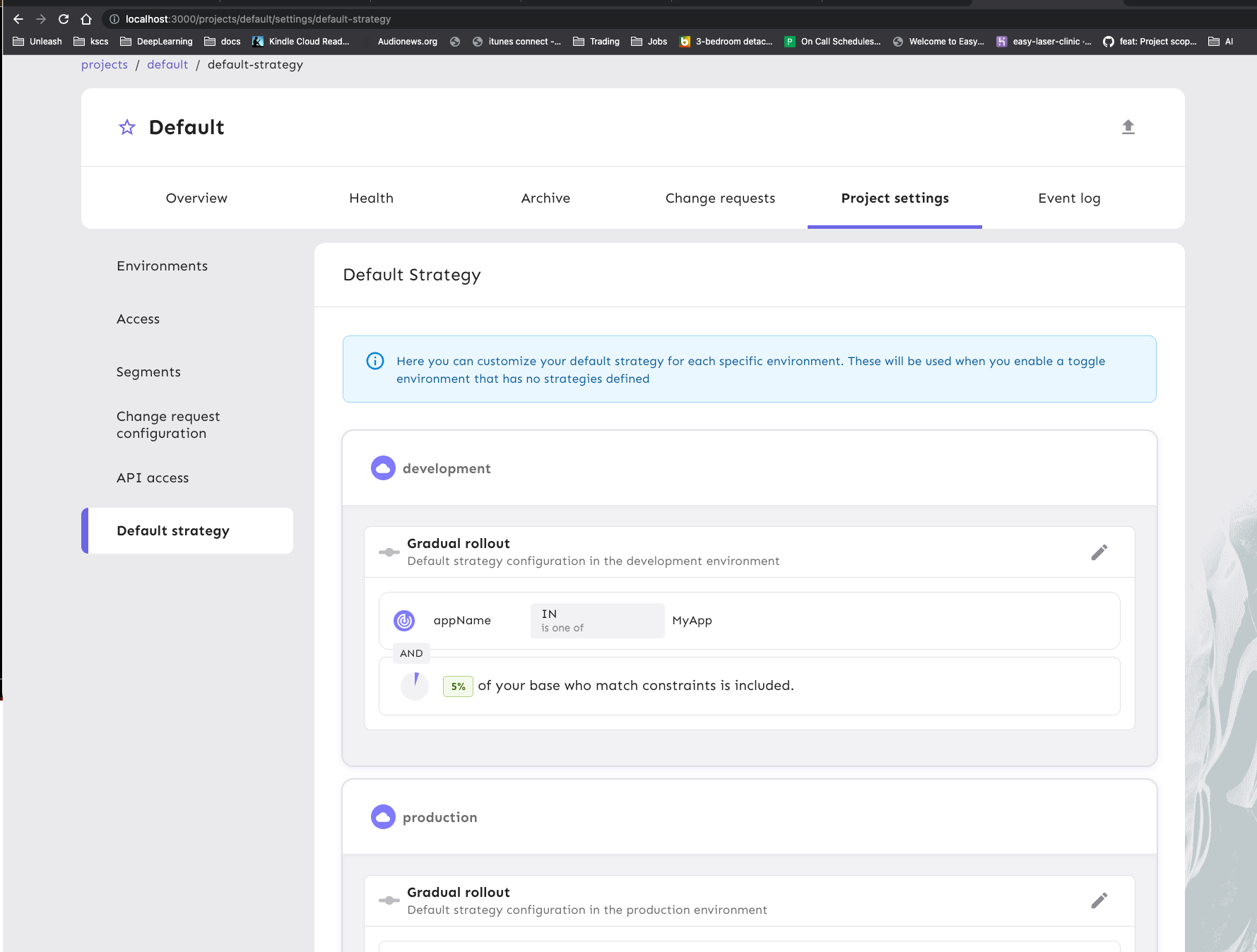
### Important files
<!-- PRs can contain a lot of changes, but not all changes are equally
important. Where should a reviewer start looking to get an overview of
the changes? Are any files particularly important? -->
## Discussion points
<!-- Anything about the PR you'd like to discuss before it gets merged?
Got any questions or doubts? -->
---------
Signed-off-by: andreas-unleash <andreas@getunleash.ai>
<!-- Thanks for creating a PR! To make it easier for reviewers and
everyone else to understand what your changes relate to, please add some
relevant content to the headings below. Feel free to ignore or delete
sections that you don't think are relevant. Thank you! ❤️ -->

## About the changes
<!-- Describe the changes introduced. What are they and why are they
being introduced? Feel free to also add screenshots or steps to view the
changes if they're visual. -->

This deprecates the `username` properties on api-token schemas, and adds
a `tokenName` property.
DB field `username` has been renamed to `token_name`, migration added
for the rename.
Both `username` and `tokenName` can be used when consuming the service,
but only one of them.

## Discussion points
<!-- Anything about the PR you'd like to discuss before it gets merged?
Got any questions or doubts? -->

There's a couple of things I'd like to get opinions on and discuss:
- Frontend still uses the deprecated `username` property
- ApiTokenSchema is used both for input and output of `Create`
controller endpoints and should be split out into separate schemas. I'll
set up a task for this

---------

Co-authored-by: Thomas Heartman <thomas@getunleash.ai>
Co-authored-by: mergify[bot] <37929162+mergify[bot]@users.noreply.github.com>
## What

This PR changes our AJV configuration to return all errors it finds with
a schema instead of stopping at the first one.

Because of this, a number of the snapshot tests that we have must be
updated.

## Why

DX! As someone using an API: if I send a faulty request, I'd rather have
the API tell me about the five things that are wrong than for me to
learn about one thing, send a new request, learn about another thing,
send a new request, .... etc.

Co-authored-by: mergify[bot] <37929162+mergify[bot]@users.noreply.github.com>
<!-- Thanks for creating a PR! To make it easier for reviewers and
everyone else to understand what your changes relate to, please add some
relevant content to the headings below. Feel free to ignore or delete
sections that you don't think are relevant. Thank you! ❤️ -->

Adds default strategy to project environment link table

## About the changes
<!-- Describe the changes introduced. What are they and why are they
being introduced? Feel free to also add screenshots or steps to view the
changes if they're visual. -->

<!-- Does it close an issue? Multiple? -->
Closes #
[1-876](https://linear.app/unleash/issue/1-876/default-strategy-backend)

<!-- (For internal contributors): Does it relate to an issue on public
roadmap? -->
<!--
Relates to [roadmap](https://github.com/orgs/Unleash/projects/10) item:
#
-->

### Important files
<!-- PRs can contain a lot of changes, but not all changes are equally
important. Where should a reviewer start looking to get an overview of
the changes? Are any files particularly important? -->


## Discussion points
<!-- Anything about the PR you'd like to discuss before it gets merged?
Got any questions or doubts? -->

---------

Signed-off-by: andreas-unleash <andreas@getunleash.ai>



